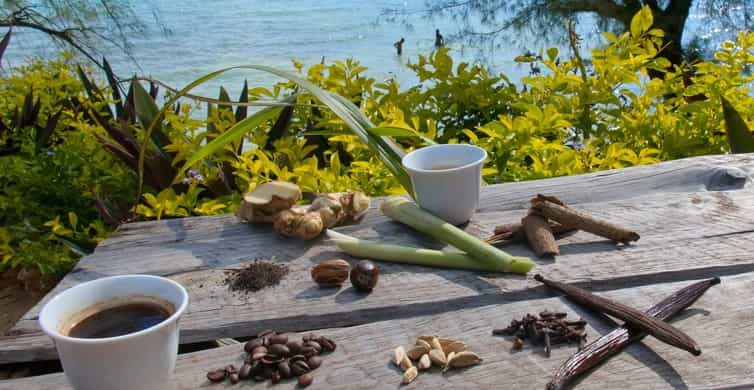
Why Zanzibar is the Spice Island
Cloves reached Zanzibar in the early 19th century. Under Sultan Seyyid Said, who ruled Oman and Zanzibar and moved his court to the island, landowners were ordered to plant clove trees, and by the middle of the century Zanzibar and Pemba were the world's largest producers of cloves. That wealth was built on the labour of enslaved people, which is worth asking your guide about.
Cloves are still grown on both islands, historically with most of the trees on Pemba, while the farms near Stone Town now combine working plots with gardens laid out for visitors.
What you see and taste on a Zanzibar spice farm
A guide walks you through the farm and invites you to guess each plant before naming it: clove buds on tall trees, nutmeg wrapped in its red mace, cinnamon bark cut fresh from the trunk, vanilla orchids climbing a support, black pepper vines, ginger, lemongrass, cocoa and the iodine plant used in local medicine. You crush leaves, smell roots and taste as you go.
Most visits end with a tasting of tropical fruit, whatever is in season, which might include jackfruit, pineapple, mango or starfruit. Helpers often weave you hats and rings from palm leaves, and someone may climb a coconut palm singing: both are done in the hope of a tip.
Where the spice farms are and how long it takes
Most spice tours visit farms in the countryside around Kizimbani and Kidichi, north-east of Stone Town. At Kidichi you can also stop at the Persian baths that Sultan Seyyid Said built in 1850. The farm walk takes about two hours, so with transfers it fills a morning or an afternoon from Stone Town; from the beach resorts, add the drive across the island.
Spice tour combinations
Because the farms are in the centre of the island, the spice tour is easy to combine with a walk around Stone Town, a boat to Prison Island or a visit to Jozani Forest, on the way to or from the east coast. Some farms serve a Swahili lunch cooked with the spices you have just seen, occasionally as a cooking class.
Tipping and buying spices to take home
At the end of the walk you are taken to a stall selling spices, oils, soaps and perfumes. There is no obligation to buy, and prices are usually higher than at Darajani market in Stone Town, though the packs tend to be better sealed for travel. Ask beforehand whether tips for the guide and helpers are expected on top of the tour price, and carry small notes.
To take spices home, choose whole spices in sealed packs (cloves, cinnamon sticks, nutmeg, vanilla pods), which keep their flavour longer than ground ones. Check your home country's customs rules on plant products, which are strict in places such as Australia and New Zealand. More ideas are in places to visit and all our Zanzibar tours.
Frequently asked questions
How long is a spice tour in Zanzibar?
About two hours on the farm, so a half day including the transfer from Stone Town.
Where are the spice farms in Zanzibar?
Mostly around Kizimbani and Kidichi, in the countryside north-east of Stone Town, about half an hour by road.
Is the Zanzibar spice tour worth it?
For most visitors, yes, especially combined with Stone Town or Jozani Forest. It is short, easy for all ages and explains a large part of the island's history.
Can I bring spices home from Zanzibar?
Dried spices in sealed packs are usually allowed for personal use, but rules vary by country and are strict in Australia and New Zealand, so check before you fly.