The north: Nungwi and Kendwa
At the northern tip of the island the tide makes the least difference: the sea stays close to the sand even at low water, so Nungwi and Kendwa are the best beaches in Zanzibar for swimming at any time of day. Both face west, which makes them the island's sunset beaches, and they have the widest choice of snorkelling, diving and sunset dhow trips.
The trade-off is development. This is the busiest stretch of coast, with large resorts, beach bars and plenty of sellers; Kendwa's wide beach is a little calmer than west Nungwi, and on the night of the monthly full moon party it is anything but quiet. Read our Nungwi and Kendwa guide.
The north-east: Matemwe, Kiwengwa, Pongwe and Uroa
South of Nungwi the coast faces the open Indian Ocean, with the reef further out. Matemwe is a long, quiet fishing-village beach opposite Mnemba Island, and boats for Mnemba snorkelling and dolphin trips leave from here and nearby Muyuni. Kiwengwa is lined with large all-inclusive resorts.
Pongwe beach is a small, sheltered bay of palm-backed sand with a handful of low-key hotels, and Uroa further south is a quiet village with simple guesthouses. On all of these beaches the water retreats a long way at low tide, often several hundred metres, so plan to swim in the few hours around high tide.
The east and south-east: Paje, Bwejuu, Jambiani and Michamvi
The south-east coast has the island's widest lagoons. Paje is Zanzibar's kitesurfing centre, Bwejuu a long, quiet beach running north towards the Michamvi peninsula, and Jambiani a stretched-out village where women farm seaweed on the lagoon floor at low tide. See Paje and Jambiani.
On the sheltered western side of the Michamvi peninsula the beaches face Chwaka Bay and get the sunset, while The Rock restaurant sits on its rock off Michamvi Pingwe. All along this coast swimming depends on the tide: at low water you walk, at high water you swim. In exchange, these villages are quieter, often cheaper and closer to Jozani Forest than the north.
The south and west: Kizimkazi, Mangapwani and the sandbanks
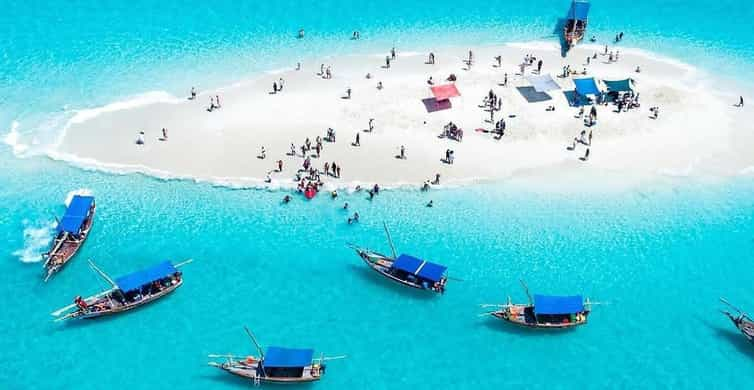
Kizimkazi, on the south-west tip, is known less for its beach than as the base for dolphin trips in the Menai Bay Conservation Area; the full-day Safari Blue also sails Menai Bay and stops on its sandbanks. North of Stone Town, Mangapwani has quiet coves between coral outcrops, plus a natural coral cave and a slave chamber cut into the rock that recall the island's slave-trade history.
Off Stone Town, the Nakupenda sandbank rises from the sea and grows or shrinks with the tide; it has no natural shade, and trips often combine it with Prison Island. Mnemba, often called an atoll, is a private island: non-guests may not land or come close, so trips snorkel the surrounding reef from the boat.
Tides, seaweed and sea temperature on Zanzibar beaches
Zanzibar has two high and two low tides a day, roughly 50 minutes later each day, and the range is largest at spring tides around full and new moon. On the east coast the reef flat is so gentle that a small drop in water level empties the lagoon for hundreds of metres. Always check a tide table before you plan a swim or a boat trip; our Zanzibar tides guide explains how to read one.
Two kinds of seaweed appear on the east coast. The farmed seaweed is grown on lines in the lagoon all year. Loose seaweed also washes up: local hotels and guides report most of it in the northerly kaskazi months, roughly December to March, and during the rains, and less from June to October, but amounts change from week to week. Better hotels rake it every morning; the north coast is much less affected.
The sea is warm all year, from about 26 °C in August to 30 °C from December to March. See Zanzibar weather and the best time to visit.
Sea urchins, dress and beach boys
Sea urchins are common in the lagoons and on rocky stretches, so wear reef shoes when you walk at low tide. Do not stand on coral, and do not buy shells or starfish.
Swimwear is fine on the beach and at your hotel, but cover up when you walk into a village; topless sunbathing and nudity are not acceptable anywhere. Ask before photographing people, including the seaweed farmers.
Young men selling boat trips, souvenirs and village tours, known as papasi, work every busy beach. A friendly but firm no is enough. If you book with one, never pay in full in advance, and check the boat has life jackets for everyone.
Which beach for whom
If you want to swim whenever you like, watch the sunset and have bars and boat trips on the doorstep, choose Nungwi or Kendwa. Kitesurfers belong in Paje. For quiet village life, try Jambiani, Matemwe or Uroa, and accept that swimming follows the tide. Families often prefer Kendwa, or a north-east hotel with a pool for the low-tide hours. Couples after seclusion tend to pick Pongwe or the Michamvi peninsula.
Many visitors split their stay between Stone Town and one coast. Compare areas in where to stay in Zanzibar and browse every destination in places to visit.