About Jozani-Chwaka Bay National Park
The park was established in 2004 and covers about 50 km² between Chwaka Bay to the north and the Pete inlet to the south. It protects the largest remaining area of natural forest on Unguja, a mix of groundwater forest that floods in the rains, coral-rag thicket, mangroves and salt marsh. Since 2016 it has formed the core of UNESCO's Jozani-Chwaka Bay Biosphere Reserve.
The park was created with the villages around it, and part of the ticket money goes back to them: it compensates farmers for crops eaten by monkeys and has helped pay for schools and water projects. Visiting with a local guide is a direct way to support that model.
The Zanzibar red colobus and other animals
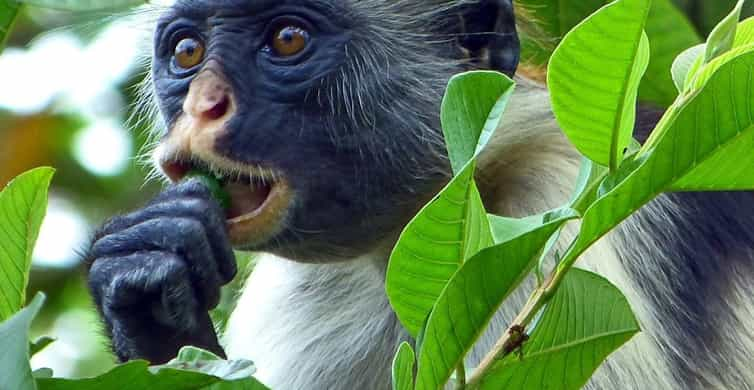
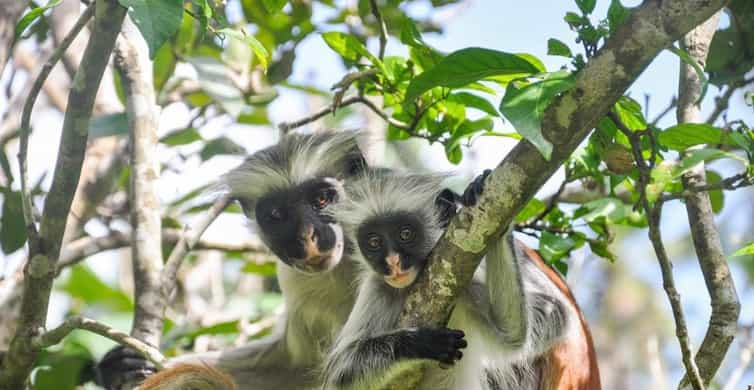
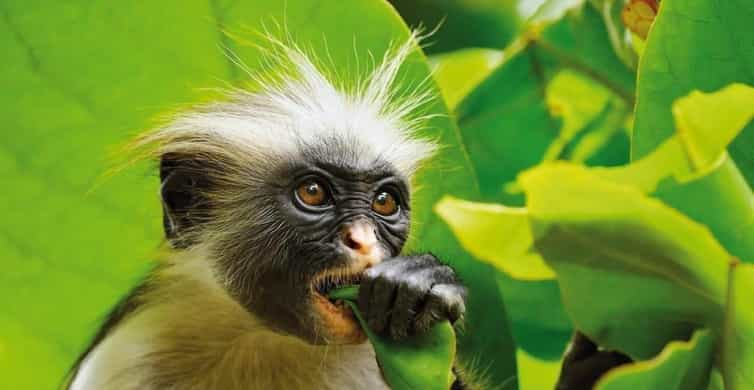
The Zanzibar red colobus (Piliocolobus kirkii), also called Kirk's red colobus after Sir John Kirk, the 19th-century British consul who brought it to the attention of science, lives only on Unguja. It is listed as Endangered on the IUCN Red List. The first full census, published in the journal Oryx, counted about 5,900 animals in 342 groups, with almost a third living outside protected areas.
Colobus live in noisy groups and feed mainly on young leaves; they cannot digest the sugars of ripe fruit. Some eat charcoal, which is thought to help them cope with the toxins in the leaves of mango and Indian almond trees. The groups living in the farmland at the forest edge are used to people, so you can usually watch them at close range on a guided walk.
Jozani is also home to Sykes's monkeys, more often seen in the forest itself, bushbabies, the small Aders' duiker and many birds; the wider biosphere reserve records 168 species. In the mangroves, look for crabs and small fish in the channels.
The forest trail and the mangrove boardwalk
Visits start at the park headquarters on the main road from Stone Town to the east coast. A park guide leads you along a nature trail through the forest, past tall trees, palms and ferns, and to the colobus groups nearby; you cannot walk the forest trail without a guide. Allow about an hour for this part.
The second part is the mangrove boardwalk, about 1 km long, built by the village of Pete at the southern end of the park. It crosses a creek between the roots of the mangroves, with water beneath at high tide and mud at low tide. The boardwalk was designed so that Pete could earn from tourism, and a share of its fees has gone directly to the village. It is usually included in the ticket but is easy to miss: ask your guide.
Entrance fee, opening hours and tours
There is no official tariff published online. Recent reports put the entrance fee for non-residents at around US$10–12 per adult, paid at the gate in dollars or shillings and including a guide; bring cash, as prices change. The park is usually open daily from about 7.30 am to 5 pm, with the last entry around 4.30 pm. The monkeys are most active in the morning and late afternoon.
Most visitors come on a half-day tour from Stone Town or their beach hotel, which includes transport, the entrance fee and a guide. Popular combinations are Jozani with a spice farm tour, or with the dolphins and The Rock restaurant on the south-east coast; compare the options in our Zanzibar tours section.
How to get there and what to combine
Jozani lies in the south-centre of the island, about 35 km south-east of Stone Town, on the road to Paje. The drive takes about 45 minutes to an hour from Stone Town and 20–25 minutes from the east coast. A taxi is the simplest option if you are not on a tour; dala-dalas from Stone Town towards the east coast pass the gate, but they are slow and crowded.
Because it is on the way, Jozani fits well into a transfer between Stone Town and the east coast, or a morning before an afternoon on the beach at Paje and Jambiani. For more ideas, see our guides to places to visit in Zanzibar and Zanzibar's beaches.
Visiting responsibly
Never feed the monkeys: human food makes them ill and teaches them to raid farms, which turns farmers against them. Keep a few metres away and follow the guide's instructions, as primates can catch human illnesses such as colds. Switch off the flash, keep your voice down and do not try to touch or attract the animals.
Stay on the trail and the boardwalk, take your litter with you, and if you drive, slow down on the road through the forest, where monkeys often cross.
Frequently asked questions
How much is the entrance fee to Jozani Forest?
Recent reports put it around US$10–12 per adult for non-residents, including a guide. There is no official tariff online, so bring cash and check at the gate.
What are the opening hours of Jozani Forest?
The park is usually open daily from about 7.30 am to 5 pm, with the last entry around 4.30 pm.
What animals can you see in Jozani Forest?
Mainly the endemic Zanzibar red colobus and Sykes's monkeys, plus bushbabies, the small Aders' duiker, many bird species, and crabs and fish in the mangroves.
How long do you need at Jozani?
About 1 h 30 to 2 hours for the guided forest trail, the colobus and the mangrove boardwalk.
How far is Jozani Forest from Stone Town?
About 35 km south-east, a drive of 45 minutes to an hour on the road to Paje.